
Tuesday, September 25, 2018

Principals of Design in Photography
Examples of Design Principles in Photography
Texture - Take a Close-up pic to capture rough, smooth, cracked, bumpy, etc


Variety - Take a picture with an interesting/different mix of objects

Unity/Harmony - Take a picture with a group of similar objects or values



Repetition - Rhythm


Proportion - Scale - Use differences in size to create a composition


Emphasis - Focal point - Use Shallow depth of Field

Movement - Use Freeze Action or Motion Blur


Balance - Symmetrical and Asymmetrical


Texture - Take a Close-up pic to capture rough, smooth, cracked, bumpy, etc
Variety - Take a picture with an interesting/different mix of objects
Unity/Harmony - Take a picture with a group of similar objects or values
Repetition - Rhythm
Proportion - Scale - Use differences in size to create a composition
Emphasis - Focal point - Use Shallow depth of Field
Movement - Use Freeze Action or Motion Blur
Balance - Symmetrical and Asymmetrical
Wednesday, September 19, 2018
9-21-2018 - I am out of class today - Complete the Scholastic Magazine Assignment
Please read and answer the questions.
Don't write on the handouts!
Write down the questions and answers in a new blog post titled "Scholastic Magazine".
Don't write on the handouts!
Write down the questions and answers in a new blog post titled "Scholastic Magazine".
Point of View and Leading Lines
Today we will talk about Point of View and Leading Lines.
When taking pictures, don't just shoot at Eye level. Change your perspective and Point of View!
Take a look at the examples at the site below.
http://digital-photography-school.com/perspective-photography-dont-just-stand-move-feet/
Bugs Eye View is essentially any image taken looking up from eye level, or lower.
Birds Eye view is looking down from eye level or higher.
Eye level is simply taking a picture from straight ahead.
Leading Lines
Leading Lines are natural lines in a scene that direct the viewer's eye to another point in the image. They may be curved, horizontal or vertical.
Take a look at the examples at the site below.
http://digital-photography-school.com/perspective-photography-dont-just-stand-move-feet/
Bugs Eye View is essentially any image taken looking up from eye level, or lower.
Birds Eye view is looking down from eye level or higher.
Eye level is simply taking a picture from straight ahead.
Leading Lines
Leading Lines are natural lines in a scene that direct the viewer's eye to another point in the image. They may be curved, horizontal or vertical.
Capture 2 Images of each of the following perspectives and post them to your blog:
Birds eye Perspective
Bugs eye
Eye Level
Horizontal Leading Lines
Vertical
Diagonal
Curves
Combination of 2 of the various perspectives.Curves
Make sure to label each picture.
Rule of Thirds Exercise
Today you will take pictures using the Rule of Thirds.
You will need to post 6 examples of the Rule of Thirds to your blog. For each example write an explanation of how the rule of thirds was used in each picture.
Here is a good example of what your post should look like.
Repeat this for 6 photos, plus one that BREAKS the Rule of Thirds.
Repeat this for 6 photos, plus one that BREAKS the Rule of Thirds.
Monday, September 17, 2018
Composing a Photograph Using the Rule of Thirds
Today you will take pictures using the Rule of Thirds. You will need to post 6 examples of the Rule of Thirds to your blog. For each example write an explanation of how the rule of thirds was used in each picture.
The rule of thirds is probably the most often referenced photography rule of composition. It is all about subject placement within the frame.
Imagine that your picture space is divided into thirds both horizontally and vertically, like a tic tac toe grid.
Here is a good example of what your post should look like. Repeat this for 6 photos, plus one that BREAKS the Rule of Thirds.
The rule of thirds is probably the most often referenced photography rule of composition. It is all about subject placement within the frame.
Imagine that your picture space is divided into thirds both horizontally and vertically, like a tic tac toe grid.

The photography rule of thirds tells us to align our subject with one of the points where those lines cross. That means our subject is one third of the way “into” the picture space – from either the top or bottom, and from either the left or right. And that means it’s not in the middle.
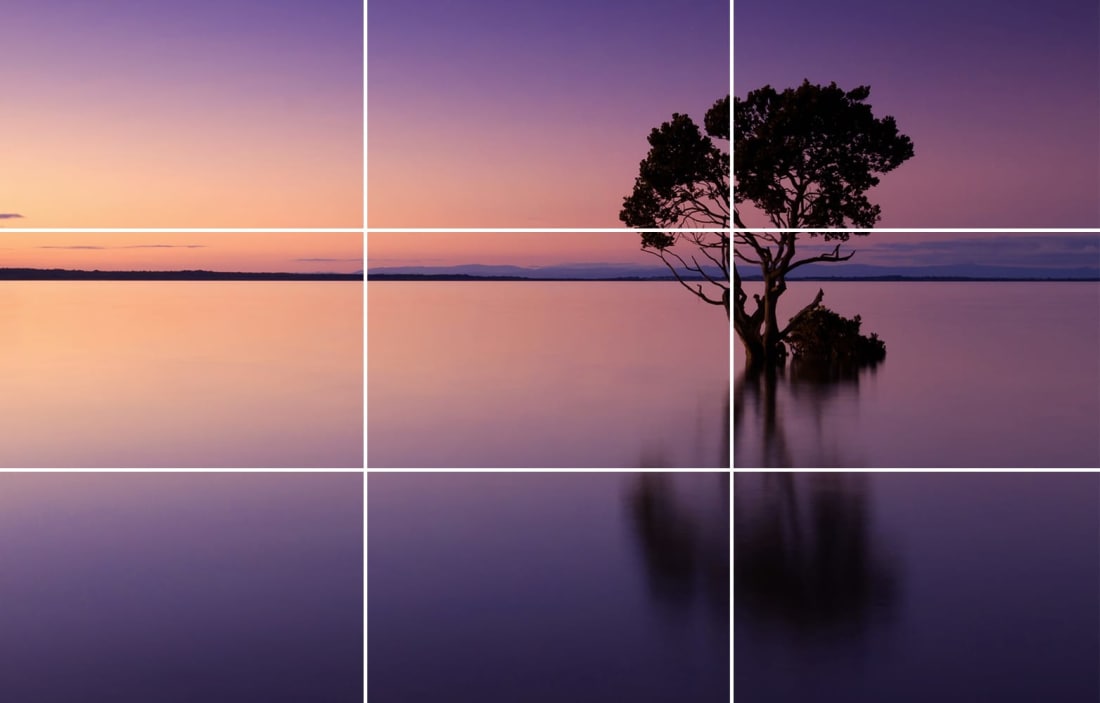
Here is an example of the rule of thirds for a landscape photo. The Focal Point, or Emphasis is on the tree and the bottom two-thirds of the photograph are composed of the lake and the top third is sky.
Here are additional links explaining and demonstrating the Rule of thirds.
http://digital-photography-school.com/rule-of-thirds
http://learnprophotography.com/rule-of-thirds
http://www.ultimate-photo-tips.com/photography-rule-of-thirds.html
Thursday, September 13, 2018
Elements of Exposure Review - Technical Challenges
Lets go outside and take some technically challenging photos that use all of the Elements of Exposure.
Take 4 correctly exposed Photos:
1. Freezing Action with Shallow Depth of Field
2. Motion Blur with Shallow Depth of Field
3. Freezing Action with Deep Depth of Field
4. Motion Blur with Deep Depth of Field
Post your photos with the description and settings and answer the following....
Which picture was easiest to capture and why?
Which picture was the most difficult to capture and why?
Take 4 correctly exposed Photos:
1. Freezing Action with Shallow Depth of Field
2. Motion Blur with Shallow Depth of Field
3. Freezing Action with Deep Depth of Field
4. Motion Blur with Deep Depth of Field
Post your photos with the description and settings and answer the following....
Which picture was easiest to capture and why?
Which picture was the most difficult to capture and why?
Tuesday, September 11, 2018
Aperture-Depth of Field Exercise - Post to your Blog Today
Today you will experiment with capturing both shallow and deep Depth of Field.
Post your examples to your blog demonstrating both shallow and extended Depth of Field.
You should have 2 examples of both deep and shallow depth of Field.
follow the format below for each picture:
This pic was shot at ISO 400, Shutter Speed 1/125, aperture f 5.6.
The DoF is very shallow:

This pic was shot at ISO 1600, Shutter Speed 1/60, Aperture f 32.
it has a Deep Depth of Field.

Post your examples to your blog demonstrating both shallow and extended Depth of Field.
You should have 2 examples of both deep and shallow depth of Field.
follow the format below for each picture:
This pic was shot at ISO 400, Shutter Speed 1/125, aperture f 5.6.
The DoF is very shallow:

This pic was shot at ISO 1600, Shutter Speed 1/60, Aperture f 32.
it has a Deep Depth of Field.

Friday, September 7, 2018
Post Your Aperture/Depth of Field Practice - DUE TODAY
Post the 2 pics of the ruler that you took in class today


- One will show Shallow Depth of Field and the ISO, Shutter Speed and Aperture
- One will show Deep Depth of Field and the ISO, Shutter Speed and Aperture
Shallow D.o.F
ISO 400
Shutter Speed 1/60
Aperture f3.5

Deep D.o.F
ISO HI 1
Shutter Speed 1/60
Aperture f36

Aperture - The AMOUNT of light let into the camera
Aperture is the opening in the lens that controls the AMOUNT of light that you allow to enter the camera.
It is measured in a thing we call the F number.

As you decrease the size of the Aperture you increase the amount of the picture that is in focus. This is called Depth of field.
Watch the following video for a good explanation of how Aperture works. We'll began using different F Stops and doing Depth of Field exercises later in class.
http://www.youtube.com/watch?v=lUbjkMm_v-A
Depth of Field is the amount of the image that is in sharp focus
Here is the a link that describes how and when to use Aperture Priority
Here's link that descibes how to take better pictures using Aperture Priority.
Use the Nikons to experiment with Depth of Field around the building. Take pictures with both Shallow and Deep Depth of Field. We'll post them next class.
It is measured in a thing we call the F number.
As you decrease the size of the Aperture you increase the amount of the picture that is in focus. This is called Depth of field.
Watch the following video for a good explanation of how Aperture works. We'll began using different F Stops and doing Depth of Field exercises later in class.
http://www.youtube.com/watch?v=lUbjkMm_v-A
Depth of Field is the amount of the image that is in sharp focus
Here is the a link that describes how and when to use Aperture Priority
Here's link that descibes how to take better pictures using Aperture Priority.
Use the Nikons to experiment with Depth of Field around the building. Take pictures with both Shallow and Deep Depth of Field. We'll post them next class.
Wednesday, September 5, 2018
AP Images Critique - Due Today
Today you will choose a photo from AP Images to critique. Follow the example below to do your critique.
1. Copy the Image (or use the Snipping tool) to upload the photo to your blog.
2. Add the link from the AP site to your blog.
3. Paste the description of the photo from the AP site to your blog.
Description: Ultra-Orthodox Jewish men pray ahead of the Jewish New Year at the Western Wall, the holiest site where Jews can pray in Jerusalem's old city, Wednesday, Sept. 4, 2013. Israelis happily welcomed the Jewish New Year late Wednesday despite uncertainty and turmoil brewing on both its northern and southern borders. (AP Photo/Sebastian Scheiner)
4. Answer the following:
5. Write a Critique. Use the Critique Guide in the link above.
1. Copy the Image (or use the Snipping tool) to upload the photo to your blog.
2. Add the link from the AP site to your blog.
3. Paste the description of the photo from the AP site to your blog.
Description: Ultra-Orthodox Jewish men pray ahead of the Jewish New Year at the Western Wall, the holiest site where Jews can pray in Jerusalem's old city, Wednesday, Sept. 4, 2013. Israelis happily welcomed the Jewish New Year late Wednesday despite uncertainty and turmoil brewing on both its northern and southern borders. (AP Photo/Sebastian Scheiner)
4. Answer the following:
- Who was the photographer?
- What country and city was the photo taken in?
- What event was photographed?
- Describe the event that was photographed.
- Why is the event newsworthy? Why is it important to us?
5. Write a Critique. Use the Critique Guide in the link above.
Subscribe to:
Comments (Atom)
-
Today you will take pictures using the Rule of Thirds. You will need to post 6 examples of the Rule of Thirds to your blog. For each exampl...
-
The next Element of Exposure we will explore is Shutter Speed . Shutter Speed is - The amount of TIME you let light into the camera. ...
-
Examples of Design Principles in Photography Texture - Take a Close-up pic to capture rough, smooth, cracked, bumpy, etc Variety - Tak...


